
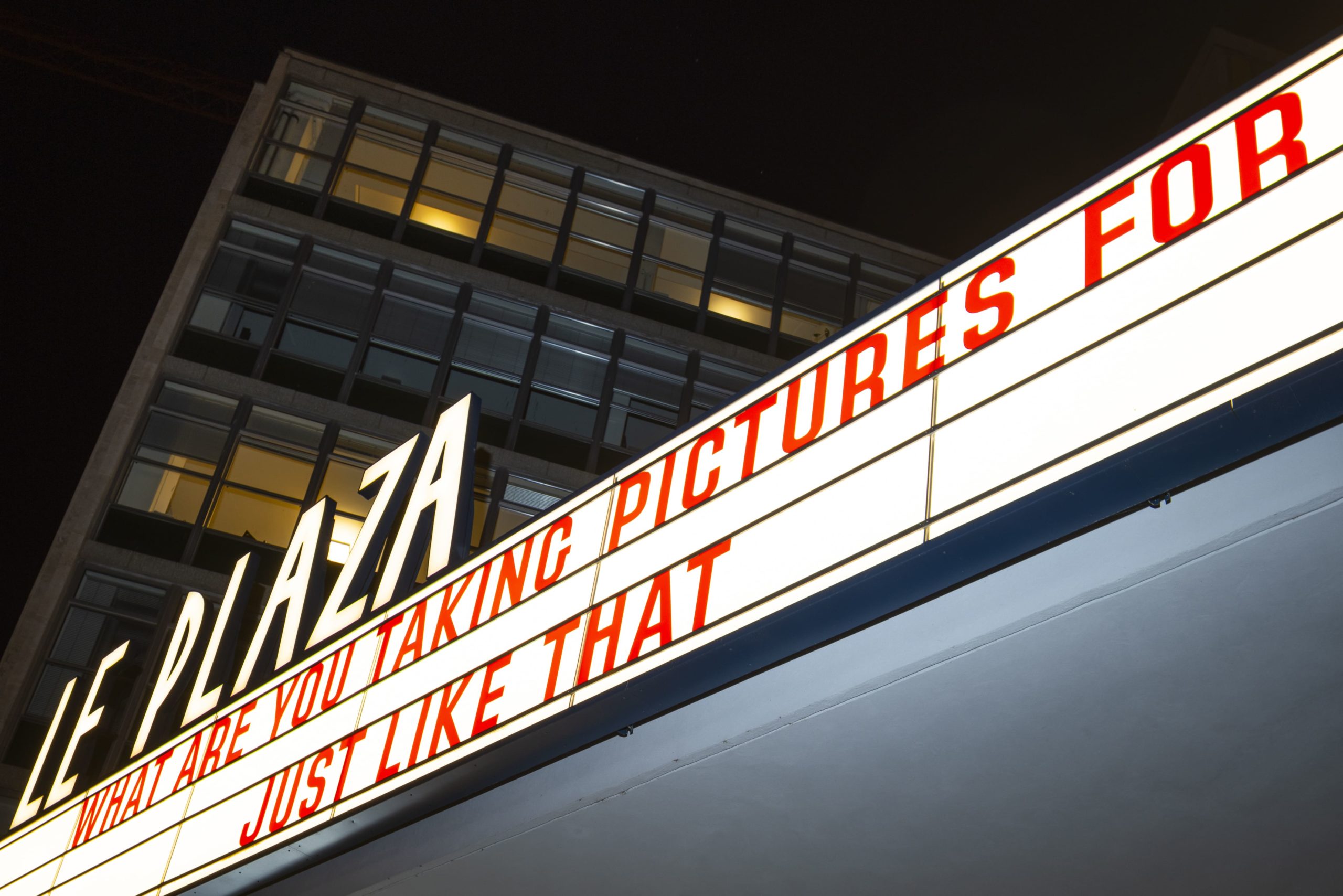
An Echo of Wenders for the Plaza’s Neon Sign
In this 16th episode of Counter-Plongée, Christian Robert-Tissot takes us back to the seminal film by Wim Wenders. Released in 1974, Alice in the Cities is a luminous meditation on wandering and uprootedness.
WHAT ARE YOU TAKING PICTURES FOR? JUST LIKE THAT
Wenders’s first original screenplay, Alice in the Cities inaugurates the trilogy devoted to wandering, which also includes Wrong Move, made the following year, and Kings of the Road, released in 1976. “Why are you taking pictures?” asks a young American boy to Philip, the German reporter photographing the dusty gas station where he has stopped. He replies, “Just like that.” To the simple question of a child who lives in the present moment comes the vague answer of an adult who photographs everything, searching for meaning.
The main character, Philip Winter, is a journalist struggling both with life and with creation, traveling across America without managing to make sense of what he sees. If he photographs compulsively, it is no longer to bear witness, but to hold on to what surrounds him, as if an emotional fracture separated him from reality. The chance encounter with Alice, a lively and perceptive little girl abandoned by her mother, introduces a new dynamic between the disenchanted adult and the child who questions the world. The journey therefore continues with the two of them, toward Germany.
The roads, motels, and train stations make the film a mirror of a world in transit. Wenders’s fourth feature film and his first critical success, Alice in the Cities explores unease with restraint, tinged with a melancholy heightened by the choice of black and white. The character of Philip Winter appears as the director’s alter ego, and Wenders would later confess his deep attachment to this film, which he considered his true first work.
Carried by its young performer Yella Rottländer and by Rüdiger Vogler, Wenders’s regular collaborator, the film anticipates themes that run throughout the filmmaker’s work, including the celebrated Paris, Texas, which won the Palme d’Or at the Cannes Film Festival in 1984: a cinema of travel and inner quest. His characters seek to reconnect with the world and with others, confronted with a feeling of loss and fragmentation.
The line borrowed by the Geneva-based artist Christian Robert-Tissot forty years later resonates strongly. Long before smartphones, before the billions of images we produce every day to fill a void or prove our presence, Wenders had already sensed this frenzy of looking. In this way, the dialogue reflects how reality tends to slip away from us today, in a world saturated with images where taking a photograph often becomes more of an automatic gesture than a conscious act.
Discover the complete From Below series by Christian Robert-Tissot, launched in December 2020. The message on the illuminated sign is renewed every three months until the official opening of the Plaza Centre Cinéma at the end of 2026.
Photo credit: Nicolas Lieber